The Ultimate Guide to Building Autonomous Multi-Agent AI Swarms in 2026
A hands-on, storytelling guide exploring how software engineers are moving from brittle single-prompt chatbots to synchronized, multi-agent AI swarms that build, test, and ship production software.

The Night My Single-Prompt AI Blew Up a Production Release
It was 2:15 AM on a rainy Thursday when I learned the hard lesson that every AI developer eventually faces: asking a single language model to be an architect, coder, tester, and security officer all in one prompt is a recipe for disaster. I had asked a flagship LLM to migrate a core authentication service from legacy sessions to JWT with refresh token rotation. For the first five turns, the conversation looked brilliant. The code looked clean, the types aligned, and the swagger docs were generated flawlessly.
Then came turn twelve. As the conversation history swelled past 60,000 tokens, the model subtly forgot our custom database transaction wrapper. It silently stripped out our rate-limiting middleware, introduced a race condition in the refresh token lookup, and cheerfully reported: 'Refactor complete and ready for deployment!' Forty minutes later, our staging environment was throwing 500 errors under minimal load. The model had suffered from classic context dilution and attention drift.
That painful incident forced our engineering team to rethink our entire AI development stack. We realized that human engineering teams do not succeed because one genius sits in a dark room trying to remember 100,000 lines of code simultaneously. Engineering teams succeed because of specialization, peer review, automated pipelines, and shared persistent documentation. That epiphany led us directly into the world of multi-agent AI swarms.
Why Monolithic LLMs Hit a Wall and How Swarms Scale
Modern foundation models are undeniably capable, but they are bounded by fundamental information-theoretic constraints. The well-documented 'lost-in-the-middle' phenomenon proves that as context windows grow beyond a few tens of thousands of tokens, retrieval accuracy from the center of the prompt degrades dramatically. Furthermore, asking an LLM to simultaneously generate creative business logic while strictly scrutinizing its own output for subtle memory leaks creates cognitive persona conflict.
A multi-agent AI swarm solves this by dividing the software development lifecycle into narrow, hyper-focused micro-personas. Instead of one massive prompt trying to remember everything, Ruflo instantiates a synchronized squad of specialized agents: a Planner Agent that maps file dependencies, a Coder Agent that receives only the immediate function context, a Compiler Agent that executes dry builds in the background, and a Security Auditor Agent whose sole mission is to find vulnerabilities in the Coder's diff.
Because each agent operates inside a tight, clean context window of just 2,000 to 5,000 tokens, instruction adherence approaches 99%. Token costs drop by over 60% because irrelevant codebase baggage is stripped away, and execution speed surges as multiple agents work on independent modules in parallel.
Choosing Your Swarm Topology: Mesh, Hierarchical, or Consensus
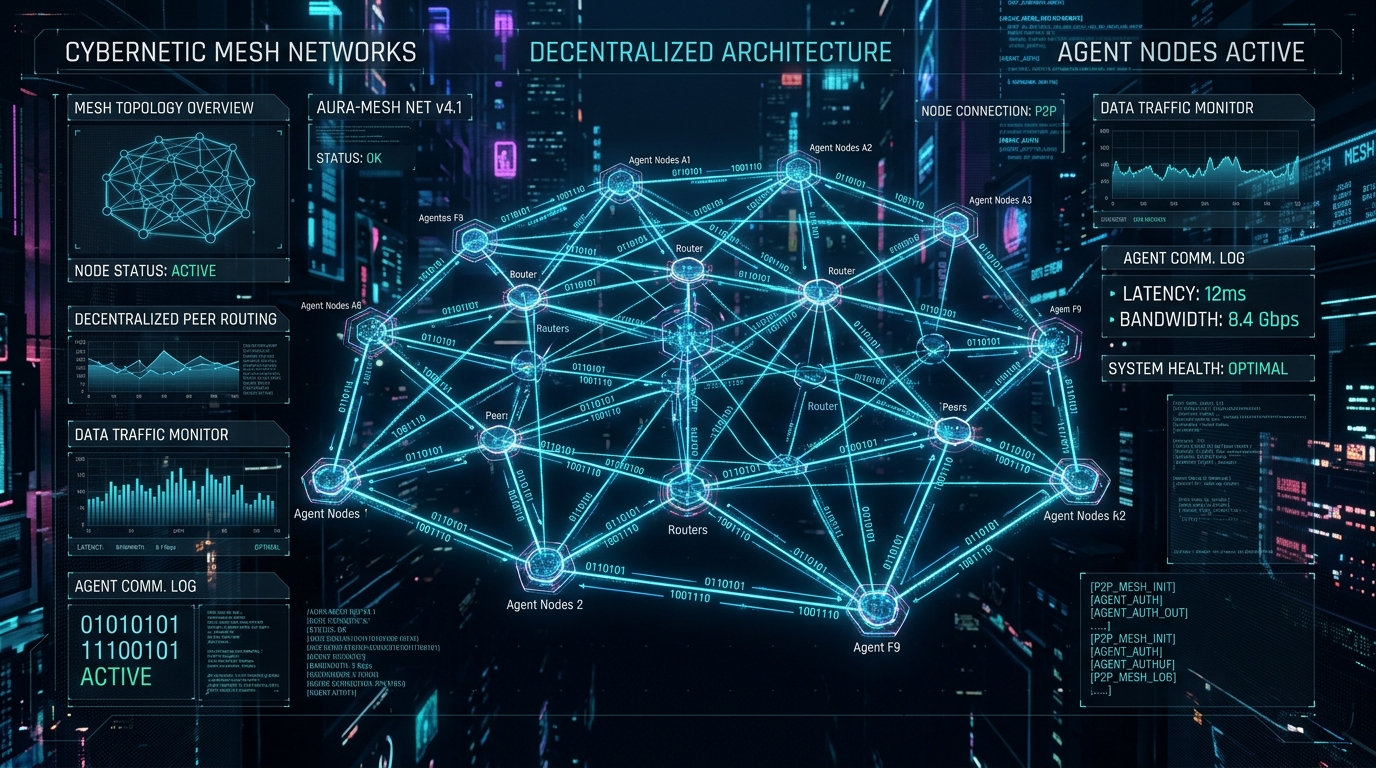
The secret to a high-performing swarm is choosing the right communication topology. Just like distributed computer networks, different software tasks demand different interaction graphs. Ruflo gives you three proven patterns out of the box:
1. Hierarchical Topology (Command and Control): A central Coordinator Agent breaks high-level features into discrete subtasks and delegates them to specialized workers. The workers report back to the coordinator, who aggregates diffs and resolves conflicts. This is the optimal pattern for rigid, predictable tasks like framework upgrades, database migrations, and REST API generation.
2. Decentralized Peer-to-Peer Mesh: Agents talk directly to each other over an event bus without routing every single message through a central bottleneck. The Coder Agent can directly ask the Database Agent for an updated schema definition, while the Linter Agent continuously reviews live file buffers. Mesh topologies shine in creative prototyping, exploratory bug hunting, and architectural brainstorming.
3. Adversarial Consensus Swarms: For mission-critical security patches or financial logic, multiple independent agents write alternative implementations. A panel of auditor agents scores each version on performance, memory usage, and security, voting on the winning pull request. This produces battle-tested code that surpasses human junior developer standards.
Step-by-Step Blueprint: Building Your First 4-Agent Engineering Swarm
Setting up your first production swarm with the Ruflo CLI takes less than 3 minutes. First, install the runtime globally: 'npm install -g @ruvnet/ruflo'. Navigate to your repository root and initialize the workspace with 'ruflo init'. This generates an 'agents.json' blueprint and a local vector memory store.
In your 'agents.json' file, define four specialized roles: 'Planner' (responsible for generating step-by-step markdown task lists), 'Developer' (equipped with file write and edit tools), 'Tester' (equipped with npm test execution permissions), and 'Reviewer' (read-only git diff auditor).
Launch your swarm with a single declarative command: 'ruflo swarm spawn --task "Implement Stripe webhook idempotency with Redis lock"'. Watch your terminal come alive as the Planner drafts the architecture, the Developer crafts the Redis key expiration logic, the Tester spins up a mocked webhook suite, and the Reviewer approves the changes before the final commit is created.
Hard-Won Production Lessons: Managing Token Latency and State Drift
After running hundreds of autonomous swarms in production, our team discovered three critical rules for operational success:
First, never pass raw file contents when a semantic summary will do. Use Ruflo's Shared Memory engine to index your repository into local SQLite vector frames. When an agent needs to know how user authentication works, it queries the memory index for the exact 20 lines of header definitions rather than loading the entire 800-line passport configuration file.
Second, enforce hard iteration limits and loop-detection gates. If an agent fails to compile a component after three automated retry attempts, the orchestrator should automatically pause, log the stack trace, and alert the human engineer rather than burning tokens in an infinite repair loop.
Third, establish immutable cryptographic audit trails. Every agent action, tool invocation, and decision path should be recorded in a local transaction log. This guarantees absolute transparency and makes debugging complex multi-agent workflows as simple as reading a standard software trace.
Frequently asked questions
Ruflo places no theoretical limit on agent counts. For local developer machines, swarms of 4 to 8 specialized agents deliver the optimal balance of execution speed, token efficiency, and system responsiveness.
No! Ruflo is completely model-agnostic. You can assign Claude 3.7 Sonnet to your primary Architect, GPT-4o to your Coder, and a lightweight local model via Ollama to your Linter to drastically reduce API costs.
Ruflo includes an atomic transactional file lock manager. When an agent requests write access, it acquires a temporary lease, preventing race conditions and file clobbering.
Yes. Ruflo features headless CLI execution mode designed specifically for automated pull request reviews, nightly vulnerability sweeps, and automated documentation generation.
No. Ruflo's vector memory and SQLite registers run 100% locally on your machine or private servers, guaranteeing enterprise-grade data sovereignty and privacy.
Ruflo includes built-in exponential backoff, request queuing, and state persistence. If an API provider throttles requests, the swarm pauses and safely resumes without losing progress.